Showing posts with label prairie. Show all posts

Friday, April 17, 2015

Thirteen-Lined Ground Squirrel


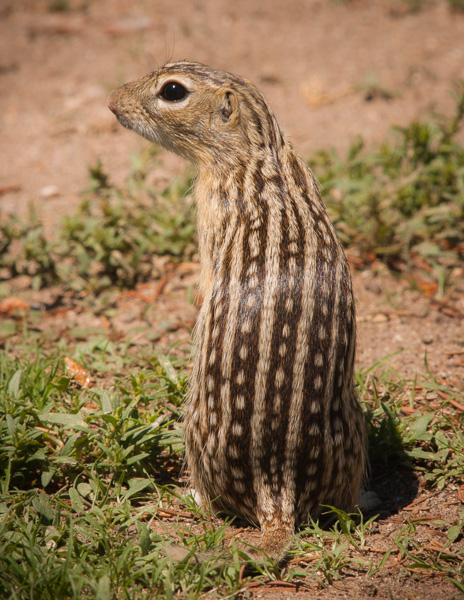
Thirteen-lined ground squirrel

The thirteen-lined ground squirrel is one of my favourite squirrels, although I have seen it on only two occasions.  It is beautifully marked, and is well camouflaged among the vegetation of the short grass prairie where it resides.  I was able to photograph this squirrel in a rest area in southern Wyoming where a colony had established and was taking advantage of the well-watered grass and occasional titbits from passing travellers.  My other sighting was a more distant view on the prairie of the Pawnie Grasslands in Eastern Colorado.


Thirteen-lined ground squirrels feed on grasshoppers as well as on grass and seeds, are active during summer, and like many squirrels, hibernate through winter.  They are very wary of predators, as although their spotted coats generally provides good camouflage, on the open prairie they are vulnerable to coyotes and birds of prey.  So as not to give away the location of their burrows, the squirrels carry away the excavated soil in their mouths rather than leaving a pile of dirt by the entrance.  They also tamp down grass and soil into the entrance to help conceal it.


Thursday, May 8, 2014

Squirrels


I love photographing squirrels, and intend to write more about them later.  For the moment, I am posting images of three very different squirrels: a tree squirrel, a ground squirrel, and a chipmunk.  Marmots and prairie dogs are also ‘squirrels’, and more closely related to ground squirrels than are tree squirrels.


This tree squirrel is a Douglas squirrel (Tamiasciurus douglasii), which has been feeding on pinecones in the eastern Sierra Nevada Mountains of California. 


The ground squirrel pictured here is a thirteen-lined ground squirrel (Spermophilus tridecemlineatus), which inhabits the prairie country of the central United States.  It hides the entrance to its burrow by taking the excavated soil away, and tamping down the disturbed area around the entrance.


This little Uinta chipmunk (Tamias umbrinus) was photographed in the pine forest on the North Rim of the Grand Canyon.  Uinta chipmunks are unusual in that they often nest in trees, rather than on the ground like other chipmunks.